MEA Network Re-analysis
Testing which neural-network changes survive spike-count and null controls
Overview
MEA Network Re-analysis
Testing which neural-network changes survive spike-count and null controls
I re-analyzed microelectrode-array recordings behind published claims about neural pair timing after bicuculline, pH shock, and impact. The question was whether changes in correlogram peaks and leader/follower classes reflected altered timing, or changed when before and after periods had different spike counts.
I froze the claim list before analysis, reproduced the paper-style metrics, then compared raw results with count-matched versions, surrogate nulls, and follow-up uncertainty checks. The outcome is mixed: several patterns persist, several are sensitive to spike count, and others need more data.
Freeze claims, then match the evidence
The analysis starts from a frozen list of paper claims and explicit before/after windows. For each recording, I recomputed the published correlogram metrics, then thinned spikes by block, subsampled pair events, and tested fixed event-count ladders. The figure shows the first count-matching pass; later statistical checks narrowed which claims could be treated as robust.
Calibrate against independent pairs
Circular-shift and timing-jitter surrogate spike trains reveal how often nominally independent pairs trigger the original metrics at different event counts. Positive-control simulations add known follower coupling to measure detection power. This separates a timing signal from metrics that change behavior simply because a correlogram contains more or fewer events.
Look below the population average
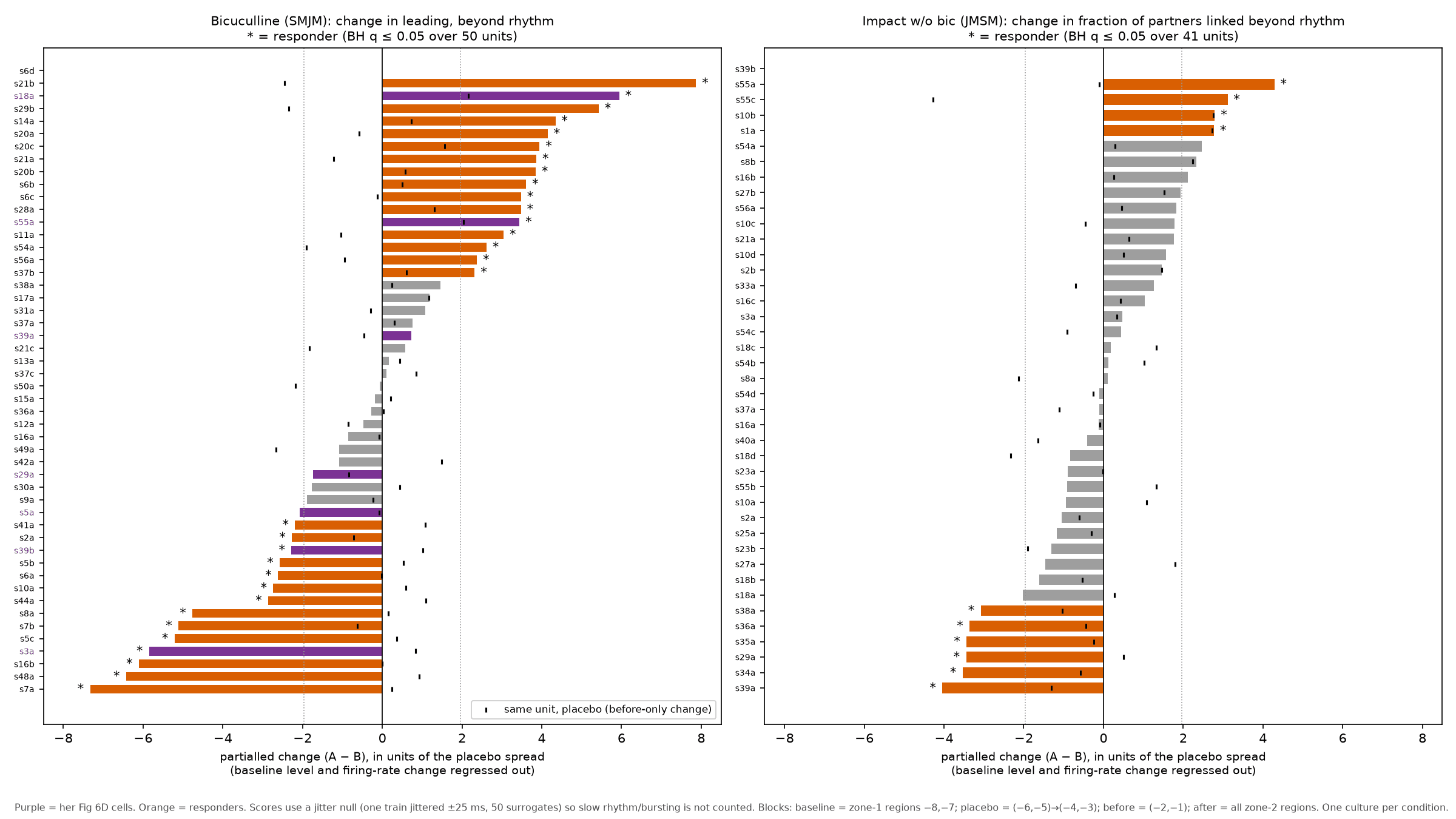
A responder analysis tracks individual units and pairs through before/after windows, including placebo-window changes. The final claim table has 16 non-exploratory claims: five classified robust by later statistical checks, four sensitive to spike count, and seven needing more data. These are within-recording assessments, not a pooled effect across cultures.
A reproducible way to distinguish timing changes that survive count and null controls from effects driven by sampling and uncertain comparisons.