BrainBERT vs. High-Gamma Activity
Testing what a pretrained neural encoder adds over a matched signal baseline
Overview
BrainBERT vs. High-Gamma Activity
Testing what a pretrained neural encoder adds over a matched signal baseline
I investigated a missing comparison in BrainBERT's baseline table: what happens when a simple high-gamma signal gets the same five-second context as the pretrained encoder? The study compares a high-gamma envelope and linear readout with frozen BrainBERT embeddings on the same selected electrodes, task splits, optimizer, and training budget.
The result is deliberately narrow. Across four tasks, the high-gamma baseline met the preregistered within-0.03-ROC-AUC criterion relative to frozen BrainBERT, while task differences were small and uncertain. Two of seven reproduction gates failed, so I keep those limits visible alongside the comparison.
The matched comparison
The core comparison holds the evaluation protocol fixed and changes the representation: a five-second high-gamma envelope with a 206-parameter linear readout versus a frozen pretrained BrainBERT encoder with a 769-parameter head. On the registered seed-42 protocol, their four-task mean ROC-AUCs were 0.6077 and 0.6012, respectively. Task differences were small; this is not a task-level win claim.
Normalization changes what the signal can tell us
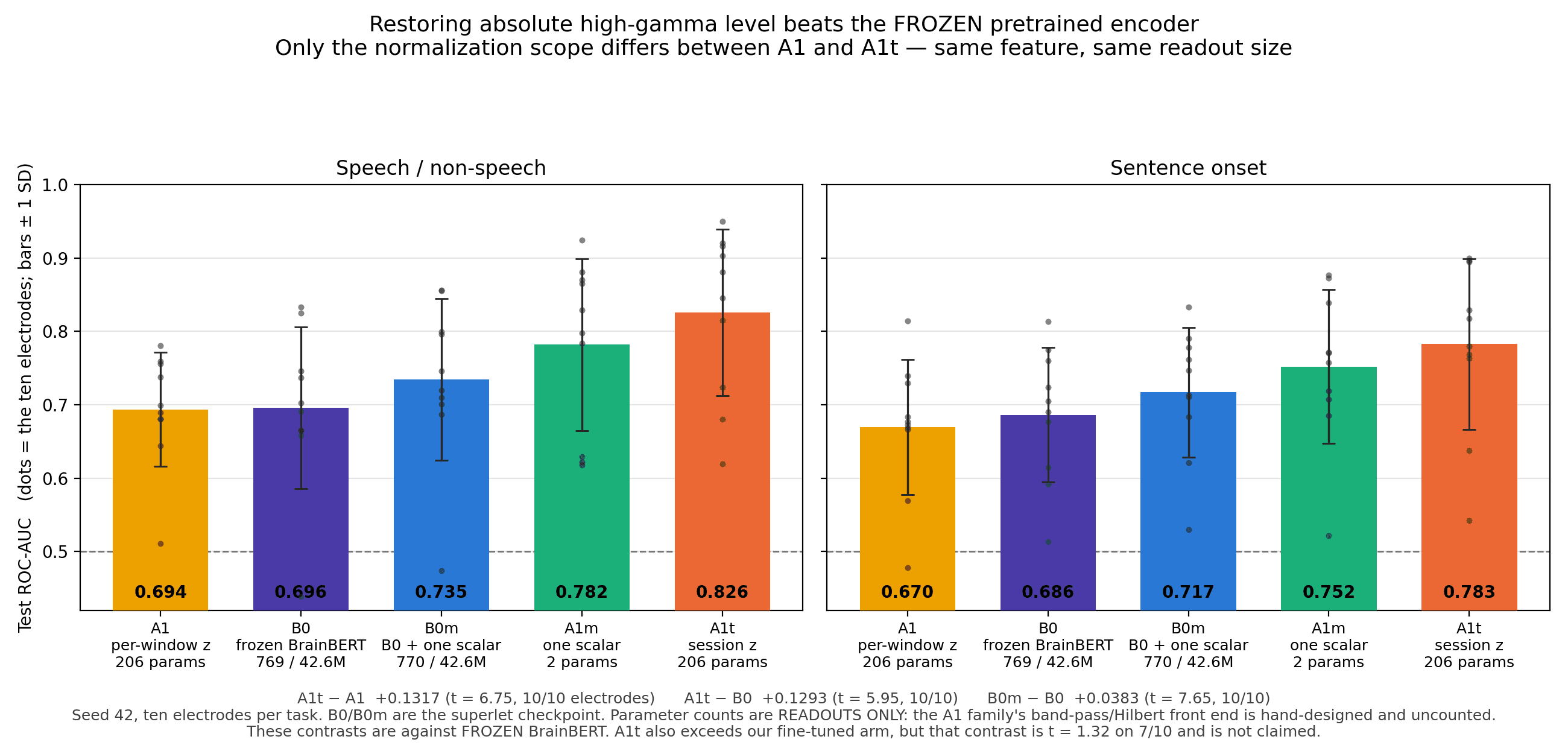
A follow-up experiment changed only the population used to estimate high-gamma normalization statistics. Preserving absolute level raised speech/non-speech ROC-AUC for the high-gamma arm from 0.694 to 0.826 on the selected electrodes in the seed-42 figure. This is an exploratory within-protocol result against frozen BrainBERT; the broader effect of normalization scope was already observed by other work.
The electrode selector can dominate the model
For the same high-gamma model and volume task, changing which ten electrodes were selected moved ROC-AUC from 0.5722 to 0.8580. The first selection used a test-informed C0 procedure; the second ranked contacts on that model's validation scores. This measures selector sensitivity, not a fair head-to-head comparison with BrainBERT on the newly selected contacts.
Additional context
Reproduction checks shaped the conclusion
The frozen BrainBERT speech/non-speech reproduction passed its registered gate (0.6962 ROC-AUC versus the published 0.69 target). Electrode-count and test-ranked baseline checks failed their registered tolerances, and the fine-tuned arm remained below its published target for an unresolved reason. Those discrepancies limit how far the result can be generalized.
The study makes the baseline comparison more informative while preserving the failed checks and uncertainty that determine what the result can support.